A Project Board Built Around How You Actually Work
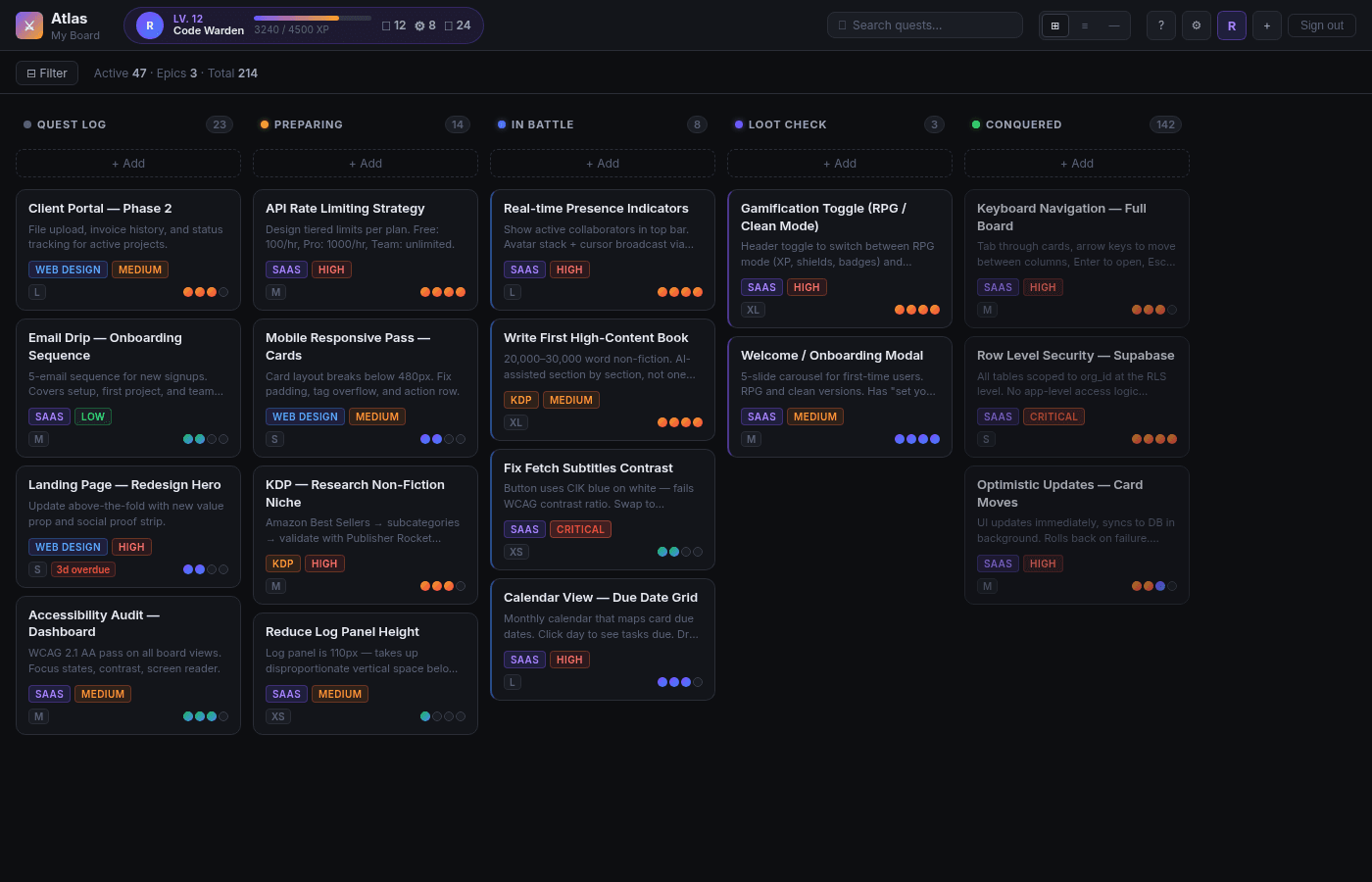
Atlas Board is a real-time Kanban board with AI-assisted task management, progress tracking, and team collaboration. Built initially for personal use, it now powers day-to-day operations at Archix Digital and is available to external teams.
Why we built it
Every project management tool we tried had the same problem: it was built for a team of 50 with a dedicated project manager, not for a two-person shop that moves fast and needs its tools to keep up. Jira is a full-time job to configure. Trello runs out of steam the moment you need more than a basic column. Notion is powerful but turns every task into a documentation exercise.
Atlas Board started as a scratch-your-own-itch project: a Kanban board that does exactly what a small, high-velocity team needs, nothing more. After six months of using it internally, it had grown into a 40+ feature product that we now use to run Archix Digital itself.
The core product
The board is built around a column-based Kanban layout with real-time sync via Supabase Realtime. Every card update, column move, and status change propagates instantly across all open sessions. No polling. No page refreshes.
Cards support subtasks, priority levels, due dates, assignees, labels, and attachments. The board view can be filtered, sorted, and grouped. There's a list view for people who prefer rows over cards, and a calendar view that maps due dates onto a month grid.
We also built a progress tracker that aggregates completion percentages across cards, columns, and entire projects. It's the first thing you see on the dashboard, which keeps the team calibrated without a standup.
The AI layer
The most-used feature wasn't one we planned from the start: an AI assistant (Atlas) that lives inside the board and can create tasks, move cards, update statuses, and answer questions about the current project state.
The assistant is built on Anthropic's Claude API and has full read/write access to the board via a structured tool interface. You can say “move everything in QA to Done” or “what's blocking the launch?” and get a useful answer or have the action taken immediately. It reads context from the board state, not from a flat prompt, so it always knows what's actually in flight.
This turned out to change how we work more than any other feature. The overhead of keeping a board up to date usually kills adoption. When you can update it in a sentence, you actually do.
Tech stack
Architecture decisions
- Optimistic updates throughout. Every user action updates the UI immediately and syncs to the database in the background. If the sync fails, the UI rolls back. This makes the board feel instantaneous even on slower connections.
- Row Level Security for team isolation. Each board is scoped to an
org_idat the Supabase RLS level. Team members can only see and modify boards they've been invited to. No application-level access control logic to maintain. - Realtime presence. When multiple team members are viewing the same board, their avatars appear in the top bar and cursor positions broadcast in real time. Small detail that makes remote collaboration feel less like working alone.
- Keyboard-first design. The board is fully navigable by keyboard. Every action from creating a card to moving it across columns to archiving it has a shortcut. Power users never have to reach for the mouse.
What we learned
Building a product for yourself is a forcing function for quality. Every rough edge you leave in is an edge you personally hit every day. The parts of Atlas Board that ended up cleanest are the parts we used most heavily: card creation, the column drag interaction, and the AI command interface.
The parts that got deprioritized (reporting, export, integrations) are exactly the parts that come up first in conversations with external teams. That gap between what you need and what users need is the most important thing dogfooding teaches you.
Where it is now
Atlas Board is live at atlas-board.vercel.app. Archix Digital runs its full project workflow through it. It's available for external teams and is actively developed, with reporting, calendar integrations, and a public API on the roadmap.
Need something built for your team?
We build tools that fit how you actually work. Tell us what you're dealing with and we'll tell you what's possible.
Start a conversation